Erjun Zhang, Ph.D.
Post-PhD Research Collaborator, CHU Sainte-Justine Research CenterPolytechnique Montreal / University of Montreal
Email: erjun.zhang [at] polymtl [dot] ca
Specializing in dMRI, Brain Neuroimaging & Microstructure Modeling
GitHub LinkedIn Google Scholar
I am a medical imaging researcher specializing in diffusion MRI modeling and its clinical translation. My work revolves around advancing diffusion MRI to study neurodevelopment and injury. During my PhD at University of Montreal, I designed and developed a spectrum-based diffusion MRI framework for evaluating neonatal brain development and characterizing sub-voxel injury heterogeneity.
I am currently developing scalable and reproducible MRI workflows that connect advanced diffusion MRI modeling with large-scale clinical cohorts, with ongoing collaborations across Canada and internationally.
My ultimate research goal is to advance MRI modeling and benchmarking frameworks to translate quantitative MRI biomarkers into precision medicine for development and injury across the brain, spinal cord, and body.
News:
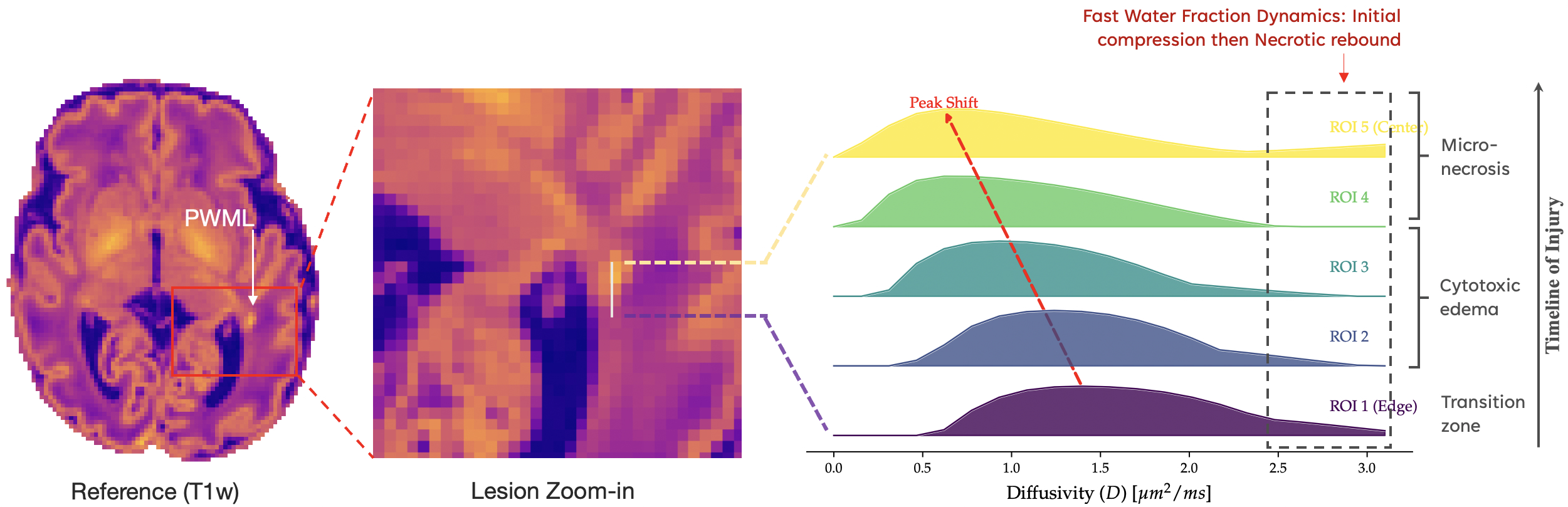
- May 28, 2026: Abstract selected for an oral presentation at EAPS 2026: “Microstructural Subtyping of Neonatal Punctate White Matter Lesions via the DBM Predicts Long-Term Neurodevelopmental Outcomes”[link]
- April 20, 2026: Completed the docker image of an end-to-end mouse brain MRI preprocessing and analysis pipeline (T1w/T2w/dMRI)
- April 15, 2026: Received an invitation to present my recent work on SDBM to the Radiology Department at Boston Children’s Hospital / Harvard Medical School. Scheduling is currently underway.
- Mar 11, 2026: Gave an invited lecture on the Diffusion Bubble Model (DBM) in the FNNDSC Lecture Series, Boston Children's Hospital / Harvard Medical School
- Feb 24, 2026: Collaborative work on evaluating neuroprotective effects in a rare brain disease using MRI is available [preprint]
- Feb 06, 2026: Returned to Dawson College for the 4th consecutive year as a Research Mentor
- Nov 2025: Continued post-PhD manuscript-related research collaboration with CHUSJ, focusing on finalizing ongoing neonatal MRI manuscripts
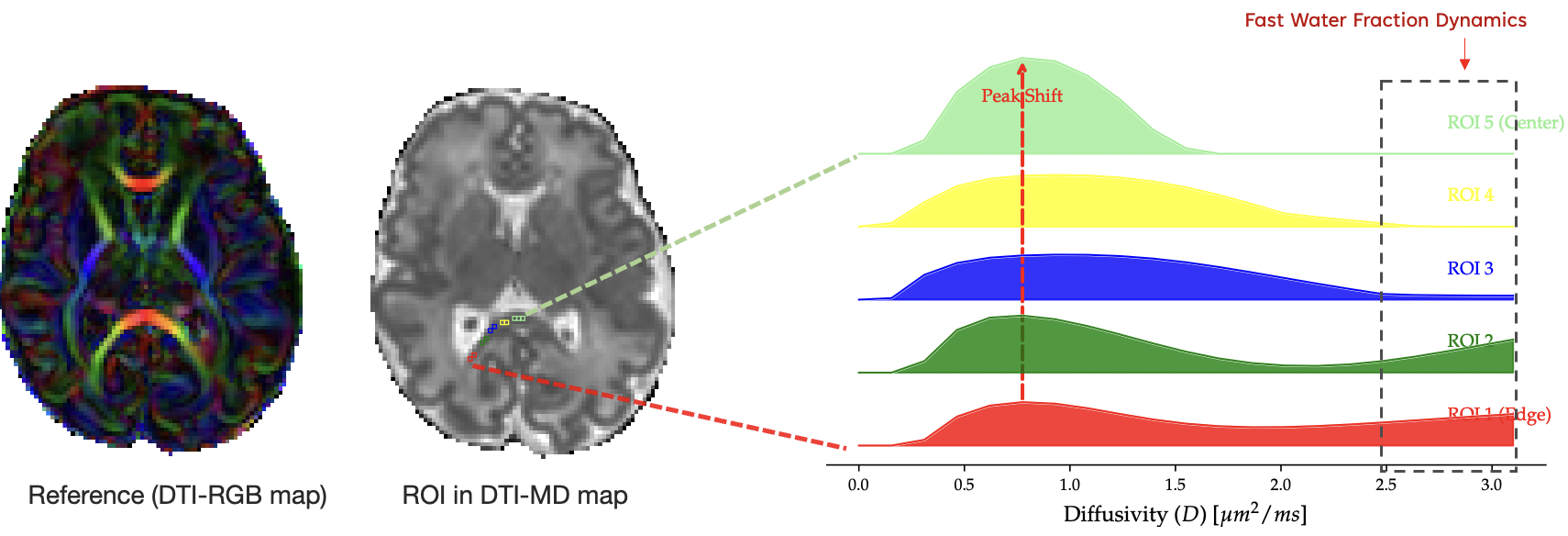
- June 2025: First-author paper accepted in NeuroImage: DBM: A Novel MRI Approach for Detection and Subtyping of PWML
[expand]
[expand all]
[collapse all]
Education
-
- PhD in Biomedical Engineering, NeuroPoly, Polytechnique Montreal, University of Montreal, Montreal, Canada, 2025
- MEng-Research in Optical Engineering, Beijing University of Technology, Beijing, China, 2018
- BEng in Optoelectronic Information Engineering, Shenzhen University, Shenzhen, China, 2014
Research Framework & Projects
- I. Methodological Innovation
-
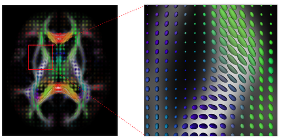
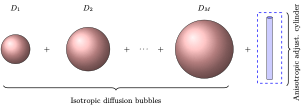
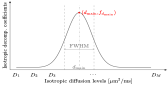
Conventional DTI often struggles to resolve complex microstructural environments, particularly in rapidly developing neonatal brain. To overcome this, I developed the Diffusion Bubble Model (DBM). By modeling water diffusion as a continuous spectrum of sub-voxel compartments, it utilizes spectral visualization and pattern metrics to precisely track brain maturation and disease pathology.
- II. Reproducible Workflows
-
- Neonatal Processing Pipeline: Built atlas-informed segmentation and registration workflows robust to motion and low-resolution clinical data.
- End-to-End Mouse MRI Pipeline: (New) Developed a fully automated preprocessing pipeline for mouse brain T1w/T2w/dMRI to support translational validation.
- III. Clinical Translation
- IV. Quantitative Analysis Tools
-
- Microstructure-Informed Segmentation: Leveraged DBM and diffusion metrics to refine brain tissue segmentation (completed in PhD thesis).
- V. Future Roadmap (Collaboration Opportunities)
-
- Non-CNS MRI Expansion: Adapting diffusion MRI models for cardiac, abdominal (liver/kidney), and muscle imaging.
- Broadening Disease Applications: Applying DBM to characterize complex pathologies beyond injury, such as Multiple Sclerosis (MS) and tumor.
- Methodological Refinement:
- Constructing population-specific parameter templates.
- Refining diffusion models with rigorous mathematical constraints.
- Deep Learning & Validation:
- Benchmarking against histology or multimodal imaging.
- Developing Physics-Informed Neural Networks for metrics estimation.
Awards & Grants
Teaching & Mentoring
Journal Publications & PhD Thesis
- PhD Thesis & Peer-Reviewed Journal Articles: Medical Imaging & Neurodevelopment
-
- The Diffusion Bubble Model: A Spectrum-Based Diffusion MRI Framework for Neonatal Brain Segmentation, Developmental Assessment, and Injury Characterization PhD Thesis, Polytechnique Montréal, 2026. [PDF]
- Diffusion Bubble Model: A Novel MRI Approach for Detection and Subtyping of Neonatal Punctate White Matter Lesions Neuroimage, 2025.
Zhang EJ, Leener BD., Lodygensky G. [pdf]- Synthetic analogue of adrenocorticotropic hormone, ACTH(4-7)PGP delays neurological manifestations in diseases of mucopolysaccharidosis III spectrum by reducing neuroinflammation and rescuing neurotransmission, synaptogenesis, and axonal demyelination [Preprint] bioRxiv, 2026.
Moore T, Dubot P, Viana G, Bose P, Zhang EJ, Nasseri B, Pan X, Robertson DN, Feulner LM, Taherzadeh M, van Vliet PP, Bonneil É, Khan S, Zhang L, Attanasio F, Singamsetty S, Durcan TM, Tomatsu S, Thibault P, Morales CR, Di Cristo G, Andelfinger G, Piñeyro G, Boehm J, Lodygensky GA, Wood J, Pshezhetsky AV. [pdf]- Severe Central Nervous System Demyelination in Sanfilippo Disease Frontiers in Molecular Neuroscience, 2023 16:1323449.
Taherzadeh M, Zhang EJ, Londono I, Leener BD, Wang S, Cooper J, Kennedy T, Morales C, Chen ZS, Lodygensky G, Pshezhetsky A [pdf]- Non-invasive in vivo MRI detects long-term microstructural brain alterations related to learning and memory impairments in a model of inflammation-induced white matter injury Behavioural Brain Research, 2022, 428-113884.
Pierre C, Zhang EJ, Londono I, DeLeener B, Lesage F, and Lodygensky G [link] - Peer-Reviewed Journal Articles: Physical Engineering & Optics
-
- Improving Thermo-optic Properties Of Smart Windows Via Coupling To Radiative Coolers Applied Optics , 59 , no. 13 (2020): D210-D220.
Zhang EJ, Cao Y, Caloz C, Skorobogatiy M. [pdf]- Simple Models For The Operation Of Partially Transparent Radiative Windows and their comparison to the radiative coolers arXiv:1906.07638.
Zhang EJ, Caloz C, Skorobogatiy M. [link] - Improving Thermo-optic Properties Of Smart Windows Via Coupling To Radiative Coolers Applied Optics , 59 , no. 13 (2020): D210-D220.
Invited Talks & Seminars
-
Decoding Neonatal Brain Microstructure: From Discrete Compartments to the Continuous Spectrum of DBM.
Invited Lecture, FNNDSC Lecture Series, Boston Children’s Hospital / Harvard Medical School, March 11, 2026.
Selected Conference Publications
-
- Microstructural Subtyping Of Neonatal Punctate White Matter Lesions Via The Diffusion Bubble Model Predicts Long-Term Neurodevelopmental Outcomes
EAPS 2026 (12th Congress of the European Academy of Paediatric Societies), Athens, Greece, 2026.
Zhang EJ, DeLeener B, Lodygensky G. [Oral Presentation]- Assessment of a central nervous system demyelination in Sanfilippo disease by diffusion tensor imaging: a non-invasive method to evaluate disease progression and therapeutic response
4th International Conference on Sanfilippo Syndrome and Related Diseases, Geneva, Switzerland, 2025.
Zhang EJ, Moore T, Dubot P, Wood J, Lodygensky GA, Pshezhetsky AV. [Oral Presentation]- T1w/T2w Ratio Improves Detection of Neonatal Punctate White Matter Lesions
CNPRM | DOHaD | ENRICH | CAMCCO 2025, Montreal, Canada, 2025.
Zhang EJ, Emadoye J, Xu K, Ton That H, De Leener B, Lodygensky G.- Diffusion Bubble Model: A Novel Method For Detecting Neuroinflammation in Mouse Brain
ISMRM 2023: Latest-breaking session, Imaging The Fire In The Brain, Toronto, Canada, 2023.
Zhang EJ, Londono I, Fouquet J, Pshezetsky A, DeLeener B, Lodygensky G. [Abstract][Slides][Video] [Oral Presentation]- Impacts of Prematurity on Neonatal Deep Gray Matter Using Diffusion Basis Spectrum Imaging
OHBM, Montreal, Canada, 2023.
Zhang EJ, et al. [Abstract][Poster]- Evaluation Of Neonatal Brain White Matter Development Using DBSI
PAS, Washington, D.C., USA, 2023.
Zhang EJ, DeLeener B, Lodygensky G. [Online Oral Presentation] - Microstructural Subtyping Of Neonatal Punctate White Matter Lesions Via The Diffusion Bubble Model Predicts Long-Term Neurodevelopmental Outcomes
Mentoring & Educational Publications
- Mentored Student Research
-
- Global Z-score Normalization Enables Training-free Automatic Detection of Punctate White Matter Lesions in Neonates
McGill Science Undergraduate Research Journal (MSURJ) OSE, Montreal, Canada, 2026.
Wat HC, Xu K, Zhang EJ (mentor), Lodygensky G.- Characterizing Neonatal PWMLs: A Cohort Study from the dHCP
92e Congrès de l'Acfas 2025, Montreal, Canada, 2025.
Emadoye J, Ton That H, Xu K, Zhang EJ (mentor), Nadeau H, Cox S, Lodygensky G, De Leener B.- Identifying, Segmenting and Analyzing PWMLs
CRBLM Careers and Trajectories Panel, Montreal, Canada, 2025.
Baker K*, Gornostayev F*, Wat HC*, Cox S, Nadeau H, Zhang EJ (mentor), De Leener B, Lodygensky G.
[Poster]- An Assessment of the Development and Maturation of Neonatal Brain Tissues Using Diffusion MRI
91e Congrès de l'Acfas 2024, Ottawa, Canada, 2024.
Xu K, Hernandez S, Zhang EJ (mentor), Lodygensky G.- Evaluation of Neonatal Brain Tissue Development Using Diffusion MRI
CHU Sainte-Justine Summer Internship Conference 2023, Montreal, Canada, 2023.
Xu K, Hernandez S, Zhang EJ (mentor), DeLeener B, Lodygensky G.
[Reports] [Slides] [Video] [PPT] [Poster] - Global Z-score Normalization Enables Training-free Automatic Detection of Punctate White Matter Lesions in Neonates
- Books & Educational Publications
-
- Linear Algebra
Liu X, Zhang EJ.
Beijing Dublin International College (BDIC), 2017. [pdf]- Advanced Mathematics Supplemental Reading Book
Zhu H, Zhang EJ, Liu X.
Beijing Dublin International College (BDIC), 2018. [pdf] - Linear Algebra
Opensource
Page content updated:
Statistics: visitors,
views (since March 31, 2023)